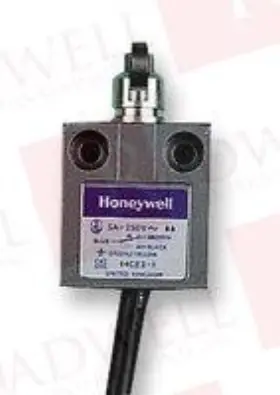
The Honeywell Micro Switch 14CE3-1 is a versatile and reliable mechanical switch designed for various industrial automation applications. This micro switch is specifically modeled as a Normally Open (NO) type, meaning that it only completes the circuit when the actuator, such as a lever or plunger, is activated.
This micro switch features a 14mm actuating stroke, which is suitable for a wide range of applications. The switch can be mounted in various orientations, including horizontal or vertical, providing flexibility and convenience for different installation setups.
The 14CE31 micro switch is constructed with robust materials, ensuring its durability under harsh industrial conditions. It has a robust, corrosion-resistant housing made of nickel-plated brass, which protects the internal components from environmental factors and wear and tear.
The switch's contact rating is 10A at 250V AC, making it suitable for low current applications. The switch has a contact resistance of less than 50 milliohms, ensuring efficient and reliable electrical contact.
The micro switch has a safety rating of IP67, which means it is protected against ingress of solid particles larger than 0.078mm and can withstand immersion in water up to 1 meter for 30 minutes. This makes it an excellent choice for applications where the switch may be exposed to moisture or dust.
The Honeywell Micro Switch 14CE3-1 is easy to install and maintain. It comes with mounting hardware and a clear actuator that allows users to easily determine the switch's status. The micro switch also features a snap-action design that ensures a positive and reliable switch contact when the actuator is activated.
In summary, the Honeywell Micro Switch 14CE3-1 is a versatile and robust mechanical switch designed for various industrial automation applications. Its 14mm actuating stroke, corrosion-resistant housing, and IP67 safety rating make it suitable for a wide range of environments and applications. Its efficient and reliable electrical contact, clear actuator, and snap-action design ensure easy installation and maintenance.
Microswitches, specifically the Honeywell 14CE31 and its variant 14CE3-1 (both are interchangeable), are commonly used for limit or proximity sensing applications in various industries. Here are some pros and cons of buying this microswitch:
Pros:1. Reliability: Honeywell microswitches are known for their durability and reliability in harsh environments. They can withstand high levels of shock and vibration, making them suitable for use in industrial applications.
2. Versatility: These microswitches come in various configurations, including normally open (NO) and normally closed (NC), and can be used for both limit and proximity sensing applications.
3. Easy to install: The microswitches are relatively simple to install, requiring only a few wires and a mounting surface. They can be mounted on a variety of surfaces, including metal, plastic, and glass.
4. Affordable: These microswitches are relatively affordable compared to other sensing technologies, making them a cost-effective option for many applications.
5. Wide operating temperature range: The microswitches can operate in a wide temperature range (-40 C to 85 C), making them suitable for use in a variety of environments.
Cons:1. Limited sensing range: Microswitches have a limited sensing range and can only detect when a switch has been actuated or a limit has been reached. They cannot provide continuous sensing data like other sensors.
2. Mechanical components: Microswitches have mechanical components that can wear out over time, requiring periodic maintenance and replacement.
3. Limited customization: Microswitches come in standard configurations and cannot be easily customized to meet specific application requirements.
4. Limited communication capabilities: Microswitches do not have the ability to communicate data wirelessly or over long distances, making them less suitable for applications that require real-time data transfer.
Conclusion:The Honeywell 14CE31 and 14CE3-1 microswitches offer reliability, versatility, and affordability for limit and proximity sensing applications. However, they have limited sensing range, mechanical components that can wear out, and limited customization and communication capabilities.
Recommendation:If you require a simple, cost-effective sensing solution for a well-defined application with a known limit or proximity requirement, then the Honeywell 14CE31 or 14CE3-1 microswitch is a suitable option. However, if you require more advanced sensing capabilities, such as continuous data transfer, customizable sensing ranges, or wireless communication, then you may need to consider other sensing technologies.
Details:
Sells new and surplus product develops channels to purchase such. Call to use a shipping service other than the ones listed. Packaging and handling: items are safely eds packaged in custom shipping cartons for protection. The product is used surplus.
All products are guaranteed to be working but may show signs of use.
specifications indusswitch:
- brand: Microswitch
- mpn: 14ce3-1
shipping indusswitch:
- type: fixed
- class: standard
- transit: 3-6 days
- service: standard
returns indusswitch:
- paid by: buyer
- policy: returns accepted
- method: money back
- time: 30 days
general indusswitch:
- category: Business & Industrial > Electrical Equipment Supplies > Limit Snap Action Switches
payments indusswitch:
- credit card: discover
- wallet: google-pay
- other
seller indusswitch:
- city: 1 millennium dr, willingboro, nj 08046
- rating: 97.0%
- # reviews: 167511
offer indusswitch:
- sold #: 15
- in stock #: 5
- prices: $10.00–$999.99
- item condition:
- New
- New – Open box
- New other (see details)
- Used
- For parts or not working
- options: ship-to-home
- started: august 13, 2025
- availability: in stock
Also Purchased:
- AML32LBK7AC: SWITCH, Honeywell
- AML51-H10C: CAP, Honeywell
- LSQYAB1A1T353: SWITCH, Honeywell
- BZE-RN2X1: SWITCH, Microswitch
- 15LT1: SWITCH LIGHT, Honeywell
- 1TL1-21M: SWITCH, Honeywell
- 2TL1-2F: SWITCH, Honeywell
- YZV-RN5: BUTTON SWITCH, Honeywell
- BZ-2RL-P4: LEVER SWITCH, Honeywell
- 703PB1: SWITCH BUTTON, Microswitch
- 2F201: SWITCH, Microswitch